
Caribbean Cruise Line Settlement

(Revised 10/13)

A Telephone Consumer Protection Act (“TCPA”) class action litigation, Birchmeier, et al. v. Caribbean Cruise Line Inc., et al., No. 1:12-cv-04069 (N.D. Ill.), has been winding its way through the court system for four years and finally settled this month. Caribbean Cruise Line and its co-defendants, who were sued for violating the TCPA by allegedly robocalling millions of individuals with offers for free cruise trips, will now pay between $56 million and $76 million, to settle claims of the approximately one million person class who received such calls from the defendants in 2011 and 2012, after the Northern District of Illinois certified several classes, granted partial summary judgment to the plaintiffs, and denied the defendants’ motions to decertify the class and for summary judgment in their own right. Individual class member recovery will be based on the number of valid claims submitted, with each class member being entitled to $500 for each call received (with a rebuttable presumption that each class member received three calls) but subject to reduction pro rata if the total payments exceed $76 million, after the costs of administration, incentive awards to the four class representatives ($10,000 each), and any award of attorneys’ fees (at most $24.5 million) are factored in. (should total payments at $500 per call (plus administration costs, incentive awards, and attorneys’ fees) be less than the $56 million settlement floor, each class member may receive a pro rata payment of more than $500 per call up to a maximum of $1,500 per call.) If the settlement is approved and Caribbean Cruise Line ultimately ends up paying the $76 million, then, as the plaintiffs’ attorneys noted in their motion for preliminary approval, the settlement “promises to go down as the largest settlement in TCPA history.”
Continue Reading Why the Caribbean Cruise Line Record-Breaking TCPA Settlement Could Contribute to “The End of the [TCPA] World As We Know It” (and We Feel Fine)

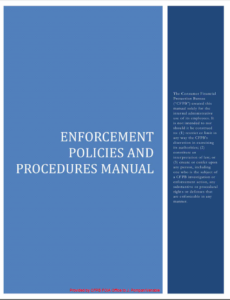
CFPB Enforcement Policies and Procedures ManualSince its launch in 2011, the Consumer Financial Protection Bureau (CFPB or Bureau) has developed a reputation for its aggressive investigation and litigation tactics. The Bureau’s Enforcement Policies and Procedures Manual for its enforcement staff provides a peek behind the curtain at how CFPB enforcement actions unfold.
Despite the CFPB’s push for transparency, a copy of the 390-page document is not available on its otherwise comprehensive website. (By comparison, the Federal Trade Commission (FTC) has for many years made available its Operating Manual as a public record.)

Following sections on document maintenance and retention policies, the manual includes a discussion of its policies governing the conduct of investigations, litigation, remedies, adjudicative proceedings, working with other law enforcement partners, practice guidance, and administrative issues, as well as model forms and sample language used in investigations and litigation by CFPB enforcement staff.

Continue Reading A Look Inside the Official CFPB Enforcement Policies and Procedures Manual

Follow the Lead Workshop

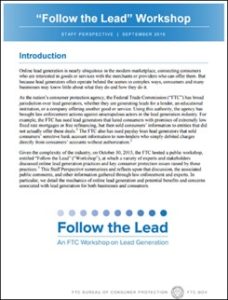
The staff of the Federal Trade Commission’s (FTC) Bureau of Consumer Protection released a much-anticipated paper on lead generation on September 15, 2016. The 13-page report provides staff perspectives on the information covered at the FTC’s October 2015 workshop on lead generation, “Follow the Lead.” Below are a few of the paper’s themes:

  • The paper describes the mechanics of lead generation and how it functions in the modern economy, including such topics as:
    • What is Lead Generation?
    • Who is Collecting Leads Online, and What happens to Them After Consumers Press “Submit”?, with descriptions of leads collected by a publisher or affiliate, leads transmitted to aggregators, leads sold to end-buyer merchants, and leads verified or supplemented with additional information.
    • A deep dive into the online lending sector’s “ping tree” model (an auction-style approach) that allows consumers to be quickly matched with lenders that can underwrite and fund loans.
    • Potential benefits to consumers and competition, including allowing interested consumers and merchants to maximally and efficiently connect with each other; and the ability to connect consumers quickly with multiple merchants, and their associated offers, that consumers may not find on their own.

Continue Reading FTC Releases Staff Perspectives on Lead Generation

Recently, there have been numerous cases dismissed because plaintiffs have treated the Telephone Consumer Protection Act (TCPA) like a business opportunity rather than as a consumer protection statute. Courts also have had to step in over the past several months to reign in plaintiffs’ counsel when it comes to their attorneys’ fees. Such is the case in a recent Seventh Circuit decision, where the court held that the TCPA does not shift attorneys’ fees or create common funds.

The TCPA provides $500 in statutory damages for each violation of the statute (or $1,500 per willful violation). The $500 cap includes both the damages to the plaintiff as well as attorneys’ fees. In Ira Holtzman, C.P.A., & Assocs. Ltd. v. Turza, Nos. 15-2164 & 15-2256, 2016 U.S. App. LEXIS 12594 (7th Cir. July 8, 2016), the court reversed an order that would have resulted in payments of more than $500 per violation plus attorneys’ fees.

Continue Reading $500 is the Max – The TCPA is Not a Fee Shifting Statute

brown and white sugar

Earlier this year, we discussed the Ninth Circuit’s decision staying a consumer class action against Chobani challenging its listing of “evaporated cane juice” as an ingredient on its yogurt labels. According to the plaintiffs in that case, “evaporated cane juice” was simply code for sugar, and Chobani therefore allegedly misled them about the healthiness of its products. The Ninth Circuit reasoned that a stay was necessary on primary jurisdiction grounds in order to allow the FDA time to complete its review of draft guidance on the use of the term. This decision was viewed as a temporary breather for food companies facing class actions challenging the use of the term. The Northern District of California’s recent decision in Swearingen v. Santa Cruz Natural, Inc., issued after the FDA published its final guidance, may signal a revival of such cases.

Continue Reading Class Action Labeling Claims Partially Evaporated, But What’s Left May Signal a Revival of “Evaporated Cane Juice” Claims

We’ve never reposted a blog, but in light of Ryan Lochte’s being robbed, then exaggerating being robbed and now maybe not exaggerating so much, and Colin Kaepernick’s decision to sit out the National Anthem, we thought this oldie but goodie on celebrity endorsers and morals clauses was worth dusting off.

One quick update on the post. The case we wrote about ultimately settled on undisclosed terms.

Continue Reading Court Refuses to Dismiss Celebrity Endorsement Breach Of Contract Case

WorkshopThe Federal Trade Commission (FTC) just released its agenda for its September 15th workshop, “Putting Disclosures to the Test,” a full-day event aimed at improving the testing of disclosures by industry, academics, and the FTC.

The workshop will review testing methodologies and examine how consumers perceive disclosures. Information will also be presented on how to test disclosure effectiveness and what types of testing are most appropriate for a given disclosure type or medium. There will also be discussion on the costs and benefits of disclosure testing.

The full agenda can be viewed here.

Continue Reading FTC Aims To Understand Disclosures Through Consumer Testing – Announces Workshop Agenda

We know that many of you not only deal with advertising but are also proud to count yourself as among the elite few who wrestle with the intricacies of the Robinson-Patman Act. If that sounds like you, read on as our own Rob Davis analyzes a recent 7th Circuit decision. If not, then stand at ease and remain blissfully ignorant of price discrimination, “like grade and quality,” promotional allowances and other such terms.

The Seventh Circuit’s Robinson-Patman Decision: What Does “Promote” Really Mean?

It might surprise many in the “real world” (which for these purposes means everyone other than antitrust/competition lawyers), but to the antitrust bar, the Robinson-Patman Act is the red-headed stepchild of competition law. Whereas competition law is now focused entirely on consumer welfare and the preservation of competition rather than the profits of competitors—even the small ones—the Robinson-Patman Act is almost obstinately about protecting the little guy. Thus, for years antitrust lawyers and the FTC have been tying themselves into knots to make the Act play well with the other antitrust laws, to varying levels of success.

Enter Clorox Bleach and the Seventh Circuit’s awkward decision in Woodman’s Food Market v. Clorox Company and Clorox Sales Company.

Continue Reading The Seventh Circuit’s Robinson-Patman Decision: What Does “Promote” Really Mean?

Demand for Olympic merchandise in the United States is resurrected every 4 years by the fervor of the televised Games. Officially, authorized and licensed gear is readily available in stores and on the Internet; however, every iteration of the Games brings with it a flood of counterfeit Olympic goods as well. The broadcasting of this year’s Olympics in Rio de Janeiro has, as expected, beckoned all sorts of counterfeit Olympic items to the U.S. market. From t-shirts illegally emblazoned with “Team USA”, to phony gold medals inscribed with the Olympic Rings. This blog post explores the laws that protect consumers and Olympics rights-holders in the United States from counterfeit Olympic goods.

Under 15 U.S.C. § 1127, a counterfeit is an article that includes unauthorized use of a logo, name, or other trademark that is “identical with, or substantially indistinguishable from” a registered trademark. The widely recognizable signs, symbols, and words affiliated with the Olympics, Paralympics, and Pan-American games are all registered trademarks. This includes, but is not limited to, the torch, the five interlocking rings, and the words “Team USA.”

Continue Reading Golden Rules: Counterfeits and the Olympics

TCPA Dismissal Raises More Questions Than It Answers

Treadmills and WeightsThe U.S. District Court for the District of New Jersey recently dismissed a putative class action alleging violations of the Telephone Consumer Protection Act (TCPA) on grounds that the Court lacked subject matter jurisdiction under Fed. R. Civ. P. 12(b)(1). Yet, the one-page dismissal order leaves more questions unanswered than it resolved.

In Susinno v. Work Out World, Inc., No. 3:15-cv-5881 (D.N.J. Aug. 1, 2016), the plaintiff alleged that Work Out World, a gym offering paid memberships, left an unsolicited voicemail message on her cell phone in violation of the TCPA. She alleged that the defendant’s actions caused her “aggravation and annoyance” and deprived her of phone time. She also claimed that putative class members may have incurred cellular telephone charges or reduced minutes as a result of the unauthorized calls.

Continue Reading No Concrete Injury or Tendering Payment = Moot?