
paintballThere may come a time (but hopefully not) where you need to write a website disclaimer, email, Facebook post, whatever trying to dispel consumer confusion and head off an advertising lawsuit.  How might you do that?  Keep editing if your first draft looks something like this:  “We have learned that some customers are confused and think that we sell ABCompetitor’s Cool Toys.  Please take note that we are not related to ABCompetitor.”

Let’s see how this played out in a recent order issued by the Northern District of California in United Tactical Systems, LLC v. Real Action Paintball, Inc., Case No. 14-cv-04050-MEJ.

Continue Reading Do Not Shoot Yourself in the Foot by Making Admissions in Your Disclaimer

The vast majority of Terms of Service (TOS) on websites are unenforceable. Companies spend a great deal of time and money in crafting what they believe to be appropriate website specific TOS which they hope will provide them with the various protections, safe harbors and advantages needed in dealing with the public or in transacting business. Countless hours are spent honing, devising, revising and fine-tuning clauses on limitations on damages, choice of forum and law, mandatory arbitration, automatic renewals, jury waivers, IP ownership clauses, assignments and licenses. Eventually, they are crafted just the way the entity wants them and they are posted. After the countless hours of design, reflection, revisions and thousands of dollars in legal fees, the appropriate well-crafted TOS appear. Unfortunately, in most cases, those bits will not have any legal byte!

When the entity goes to enforce the TOS, believing they have entered into a contract with their users, they are unpleasantly surprised time and again by judges who refuse to enforce them. 
Continue Reading Your Websites Terms of Service are Unenforceable

infinityDefining unlimited is a metaphysical exercise worthy of a Cosmos or at least a Big Bang episode.  We have blogged before about the meaning of “lifetime supply” and “free.”  But the FTC is very literal when it comes to defining the bounds of limitless and concludes that, well, unlimited means unlimited. The FTC has just filed a federal court complaint against AT&T seeking redress for customers who signed up for unlimited data plans.  In its complaint, FTC charged AT&T with engaging in an unfair and deceptive data throttling practice that targeted customers on its unlimited data plans without providing customers adequate disclosure as to the nature of the practice.

According to the FTC, despite its “unequivocal promises of unlimited data,” AT&T allegedly began throttling data speeds for its unlimited data plan customers in 2011, in which “numerous customers” experienced slow-downs of up to 85-95 percent. The FTC’s complaint claims that AT&T violated the FTC Act by changing the terms of customers’ unlimited data plans while those customers were still under contract with AT&T, and by failing to disclose the extent of the throttling program to consumers who renewed their unlimited data plans with AT&T.Continue Reading FTC: Unlimited Means Unlimited

We are close to live blogging from the annual NAD Advertising Law Conference and for those who could not join us, we wanted to share highlights from its opening — keynote speaker FTC Chairwoman Edith Ramirez.  The FTC typically uses this conference to lay out its enforcement priorities relevant to national advertisers and gives us all a peek into the crystal ball for the coming year.  So here’s what we heard.
Continue Reading Live (almost) from New York, It’s the NAD Annual Conference

Edwards' DodoThe fine print disclosure is as iconic as the Yankees, Mom and Apple Pie.  But pity the poor disclosure as it’s had a rough time of late.  First, the FTC came out with its revised Dot.com disclosures (read about those here)  In general they advocated clearer and more prominent disclaimers and also asked advertisers to think hard about whether the information should be in the body of the claim itself rather than in a disclosure.

Now the FTC has turned its attention to disclosures on television and print advertising.  “Operation Full Disclosure” resulted in warning letters being sent to 20 of the largest 100 advertisers in the country (and 60 companies overall) alerting them to the fact that the FTC believes they failed to make adequate disclosures in their TV and print ads.  The letters also asked them to notify the FTC about their response to the letter.  (The FTC has indicated that the response has been “extremely positive.”) 
Continue Reading Is the Disclosure Going the Way of the Dodo?

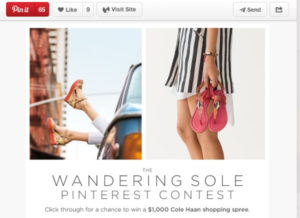
ColeHaanOn March 20, 2014, the FTC issued a closing letter to Cole Haan that will affect all kinds of advertisers (and advertisements) on social media.  In particular, it will impact the way that brands interact with users on Pinterest and tell their users to use hashtags in contests and other types of promotions.  So advertisers, #listenup!

The FTC took issue with the shoemaker’s “Wandering Sole” contest on Pinterest, which called for people to create Pinterest boards with images of five Cole Haan shoes, along with pictures of the contestants’ “favorite places to wander.”  Whoever posted the most creative entry would win a $1,000 shopping spree.  Cole Haan told users to include the hashtag “#WanderingSole” with their photos, but—importantly—it didn’t tell participants they also needed to make it clear that they posted the pins in order to enter a contest.

The FTC was concerned because this material connection (the link between the pin and the contest entry) was not disclosed in entrants’ posts.  The letter states that “entry into a contest to receive a significant prize in exchange for endorsing a product through social media constitutes a material connection that would not reasonably be expected by viewers of the endorsement.”   The FTC observed that the participants’ pins featuring Cole Haan products were endorsements of the company’s products, and the #WanderingSole hashtag ineffectively communicated the financial incentive—a material connection—between Cole Haan and the entrant.

Continue Reading FTC Gives Cole Haan’s Contest the #Boot

In 2009, the FTC issued revised Guides Concerning the Use of Endorsements and Testimonials in Advertising and many expected a rash of enforcement in that area. The FTC also has promised to scrutinize statements made in the context of talk shows, which the FTC believes may constitute advertising. Although the FTC has brought a few cases challenging advertisers failure to disclose a material connection (see Spokeo, Reverb, and Legacy Learning cases) this area has not appeared to be a priority. In some instances the Commission has also opted to essentially issue a “warning,” exercising its discretion to close certain matters without bringing an enforcement action. Now, however, the FTC appears to be pursuing both endorsements and statements made on talk shows in an action announced on March 6, 2014, against ADT, a home security company. The agency alleges that ADT misrepresented the statements of paid endorsers as independent opinions of safety and technology experts.

The Complaint alleges that ADT paid three spokespersons, a child safety expert, a home security expert, and a technology expert, over $300,000 to endorse and promote the ADT Pulse home monitoring system. The endorsers also received a free Pulse system, valued at more than $4,000. The endorsers plugged the products in television interviews, radio interviews, and on blogs, with almost no mention of their connection to ADT. According to the FTC, consumers would interpret the endorsers’ recommendations of the product as the opinion of an independent expert, not an advertisement involving a paid spokesperson.
Continue Reading FTC (Finally) Sounds the Alarm on Endorsements

We have written a lot about the emerging legal issues with “native advertising” and eagerly track case development at the NAD (Qualcomm, eSalon and Shape) as well as the FTC. And so much more is covered in the marketing press about what native advertising is and how can it be scaled. Marketers agree the ideal of native advertising is to create content so compelling that consumers flock to engage, and in the process connect with the brand behind the content. Many are deeply suspicious. Publishers for one, who take passionate and almost violent pride in protecting the line between editorial and advertising content. And many question whether advertisers can be really engaging. As lawyers to the marketers, we find good marketing to be wildly entertaining and have faith this can be accomplished. And we did not have to look far to find this brilliant example. While we seek out every opportunity to bring you witty videos (and sometimes work hard to craft a legal musing around them, this may be our best link ever. Please take a moment to enjoy and we will be back with you shortly:

How awesome was that?
Continue Reading The Nirvana of Native Advertising – will Lawyers Screw It Up?

Every year, we look forward to the Super Bowl.  For the commercials.  Our friends and family laugh at us, but they get it since advertising law is what we do.  This year, when the game did not prove to be an equal match up, after exhausting the wing and nacho bowl, many others turned to commercials as their prime source of entertainment (after Bruno Mars of course – we were doubters but he owned that stage!)  Our children became proud of what we did (that is until we explained that in our jobs we were mostly responsible for the fine print at the bottom of the screen).  As every year we look for a theme and this year we did not have to look far.  The ads were filled with celebrities.  Stephen Colbert’s head cracking open like a pistachio;  Naked David Beckham losing his H&M skivvies; a Full House reunion for Dannon; Scarlett Johansson sexily slurping her SodaStream; Jason Statham blasting and jumping out of a plane on his way to enjoy his Xfinity; Tim Tebow without a contract for T-Mobile; and John Krasinski for e-Insurance.  And most of the car companies led with a famous face: Terry Crews finding joy in music with the Muppets in a Toyota Highlander;  Laurence Fishburne reprising his Matrix role of Morpheus for Kia; Bob Dylan and Chrysler; Johnny Galecki in his Hyundai Big Bang striking out with the lady in the car next to him; Audi and the Doberhuahua feat. Sarah McLachhlan‎, and Bruce Willis for safe Honda cars.  And then there was the anti-celebrity ad run by T-Mobile.

Celebrity endorsements are nothing new but raise some issues brands should consider,
Continue Reading Come for the Game; Stay for the Commercials: Celebrities Dominate Super Bowl

Editor’s Note:

As promised, here is an update on ASA Developments from our friends at Lewis Silkin LLP. We were very interested in this case development from the UK around the issue of whether good faith reliance on a third party’s representations is sufficient due diligence to support claims. Below you will find an alert